How to get your wellness business found in Kingston
You want as many clients as you can get, so you try to show up for every search that might bring one in. That spreads your SEO effort thin instead of putting it behind the one search that actually brings in the right person. For my own business, I checked who ranks for personal trainer and health coach SEO in Kingston upon Thames, and found that nobody had claimed that specific combination. Here is how to check whether your own business has the same gap, and where to start fixing it.
By Eva Petrakova · Local Business Systems

Why being found locally matters more than being found everywhere
A personal trainer or health coach can work with someone anywhere, over video. But local has something digital cannot replace: knowing the area itself. Which park has decent ground for sprint work, which café actually does a protein-friendly breakfast, which gym has space at 6am. That local knowledge is part of what you offer, even if the session itself happens on a screen.
Google knows this too. Search results, and Google's AI Overviews, both use the location of the person searching to decide what to show them, especially for anything with local intent like "personal trainer near me." A page that names Kingston upon Thames specifically has a real advantage over one that does not, for exactly this reason.
It also means the competition is different than it looks. You are not really up against every personal trainer in the country. You are up against the handful of people in Kingston upon Thames who show up when someone here searches. That is a far smaller, far winnable race, and most of the businesses in it are not actually trying to win it.
If you want to grow beyond this one area eventually, that is not a reason to spread yourself thin now. Dominating local first gives you the foundation, the data, and the experience to expand properly later, rather than showing up everywhere at once and standing out nowhere.
A page that knows your industry and your area only has to be right once. A generic page has to be lucky.
What I found when I checked who actually ranks
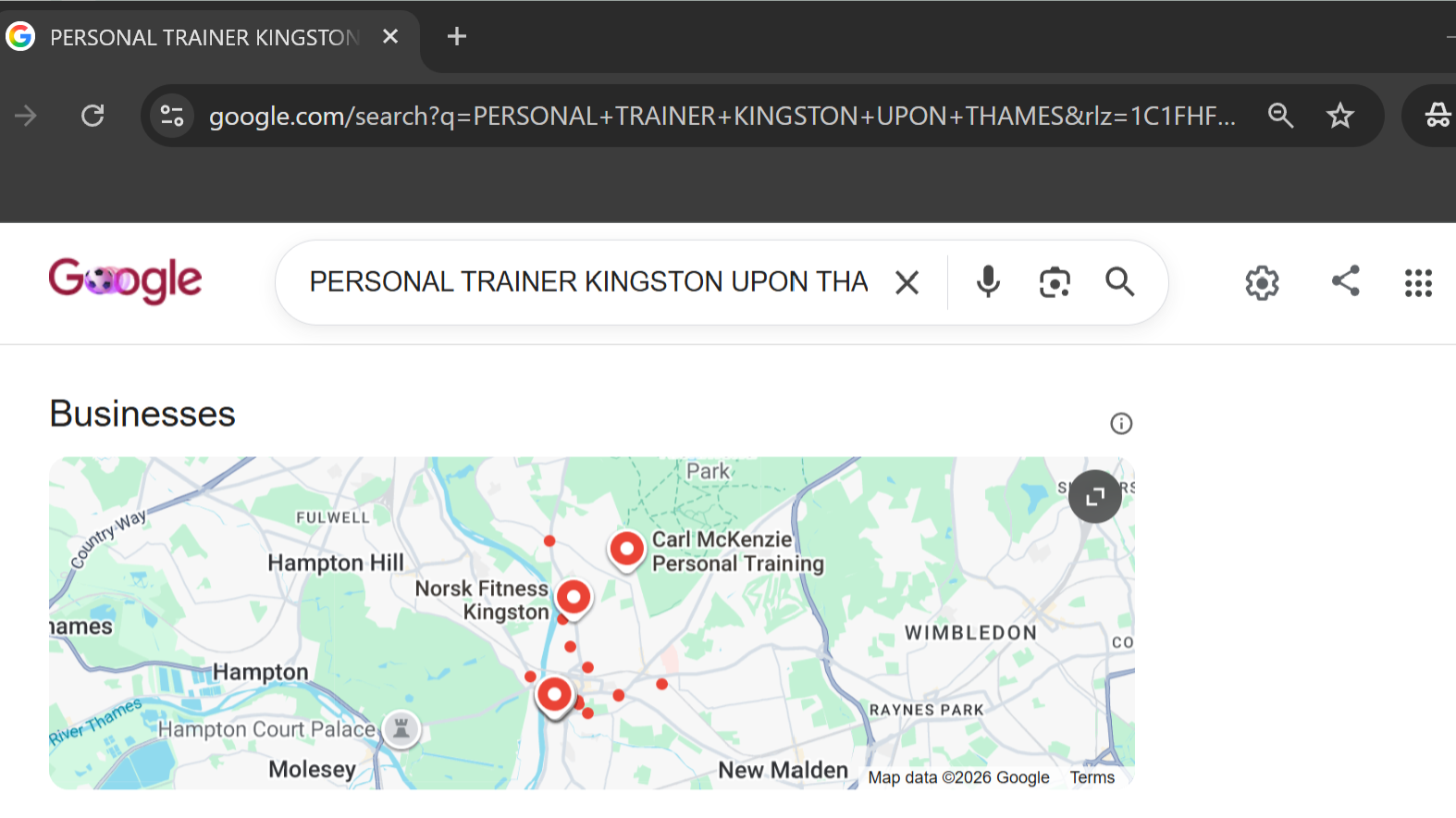
Today I searched for who shows up if a personal trainer or health coach in Kingston looked for help getting found online. I expected this to be a crowded, well-served space. It was not.
I found four real competitors. Two were generic local SEO agencies in Kingston with no mention of personal trainers, fitness, or coaching anywhere on their pages. The other two were genuine fitness and personal training specialists, but neither mentioned Kingston, or any specific town, anywhere at all.
Nobody had combined the two. Not the niche and the location together, on one page, for one audience.
It surprised me at first, and then it made sense. If an agency is trying to serve every kind of business, in every town, the number of niche-and-location combinations to manage becomes enormous. It is far easier to build one generic page than hundreds of specific ones. The cost of that choice falls on the business owner searching for help, who finds someone who knows their industry but not their area, or someone in their area who does not understand their industry.
How to check your own business for the same gap
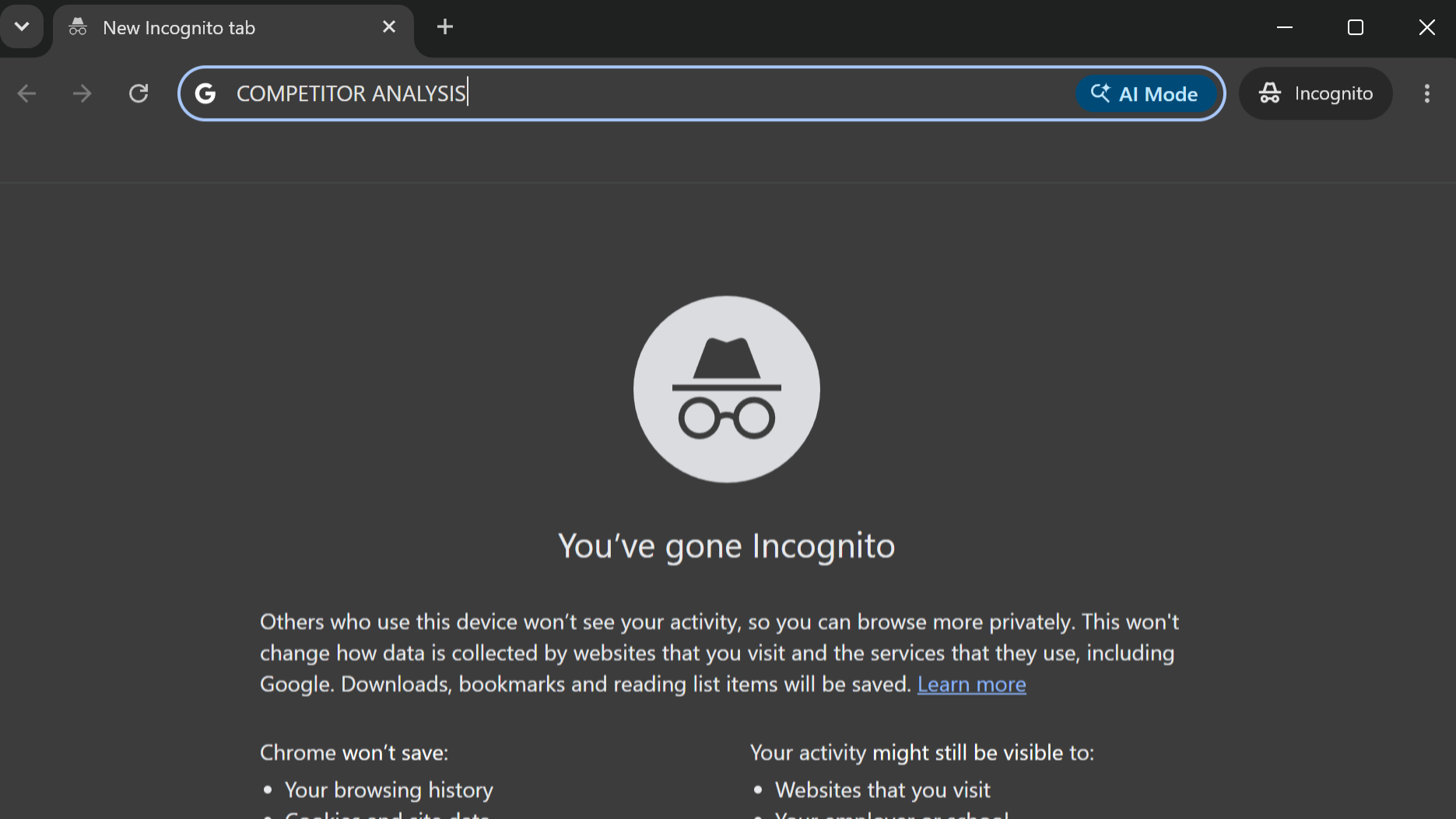
You can run a version of this check yourself in a few minutes. Use an incognito browser, or borrow someone else's device, and search for the exact service you offer plus your area. Something specific, like "menopause specialist Kingston" or "chronic pain therapist Kingston," not just your business name.
The same exercise works on AI tools, and it is worth doing separately, because they answer from different sources than Google does. The controls are stricter though:here is how to check whether AI recommends your business without getting a flattering answer that means nothing.
Ignore the sponsored results at the top, and ignore directory listings (sites like Yell or Bark that collect lots of businesses in one place rather than being a business themselves). Look at where you appear, first page or second, and then look properly at your top three real competitors. They are showing up at the top because they are doing something well enough to earn that position, which is exactly what makes them worth studying.
A few things to check on their pages, the same things I checked on mine and on theirs today:
Does their page title actually name the service and the area together? Two of the four pages I found never mentioned Kingston at all, despite appearing in a Kingston search.
Is the writing genuinely clear, or full of jargon? One of the four scored "very confusing" on a standard readability check.
Does the page read like it was written for that specific business, or could you swap in a different industry and town and it would still make sense? The most relevant page I found used the same exact phrasing to describe a completely different kind of business elsewhere on its own site.
Do they have a meta description at all? This is the short line of text that shows under a page's title in search results. One of the four competitors had none.
The same check is worth running on your Google Business Profile, not just your website. They get found in different ways, anda profile and a website are not the same search, even when people assume one covers the other.
If you want somewhere to start on the profile itself, here isthe same checklist I use to set up every client profile from scratch, free, no obligation.
Where to start fixing it
Start with the title. If a search engine cannot tell what you do and where, it has no reason to recommend you to anyone, anywhere. Once your title names your service and your area together, mention that same wording naturally a few times through the page, so the whole thing reads as genuinely relevant, not just the title.
After that, focus on writing that is actually useful and easy to read, not stuffed with jargon. Being genuinely clear and helpful for the person reading is generally understood to matter more than trying to satisfy a search algorithm directly. The algorithm is not who you are trying to reach.
Then look at whether the page reads as written specifically for your business, not a template that could describe anyone. The meta description matters too, but it comes after those three, because clarity and relevance are what actually bring people in. Chasing the algorithm instead of the person reading is the wrong problem to solve first.
If you do not have time to fix this yourself
Most people I speak to are in one of two situations. Either you are fully booked and this is the last thing you have time for. Or you are not yet where you want to be, and you do not want to spend the next six months figuring out SEO when that time could go into actually getting clients.
If you recognise this gap in your own business and want a second pair of eyes, get in touch. I look at your existing online presence and SEO before we even speak, so we can both see honestly whether I am a good fit to help.
I only work with personal trainers and health and wellness coaches, which means the problems you run into are not new to me. Clients who go quiet after a few sessions, the awkwardness of asking for a review after something personal like a weight-loss or rehab programme, certifications that matter to a prospective client but mean nothing to a generic SEO agency. I have already seen these before I get to yours.
Getting found is the first problem, not the only one. Once enquiries start coming in,what to automate firstbecomes the next real question, so the admin does not quietly eat the time the visibility just bought you.
I work withpersonal trainers and other health and wellness professionals in Kingston upon Thames. I want to see your business succeeding the next time I walk past it. Local is the best place to start.
© 2026 Local Business Systems. All rights reserved.