How Do I Check If AI Recommends My Business?
I asked an AI tool who does local SEO for fitness and wellness businesses around Kingston. It told me nobody does, three separate times, before admitting it had not actually searched.
By Eva Petrakova · Local Business Systems · 29 August 2026
One evening I was on my phone, scrolling, not doing anything much. I had recently built an AI visibility check as a service, run it on my own business, then improved both the check and my SEO. My business is young. Ordinary SEO takes months to build up, but I was not sure the same was true of the AI tools that more and more people now use when they are about to buy something.
So I typed in the first question from my own check. Who does local SEO for fitness and wellness professionals in Kingston, Surbiton and the surrounding areas.
Gemini did not mention my business. It said no one does that.
Did it actually search, or did it just answer?
I pushed back four times, and the fourth push is the one that mattered.
First it gave me local Kingston agencies and UK-wide fitness SEO specialists, in two neat categories. Then it told me what a fitness SEO specialist focuses on, quoting a competitor's website as the source. Then it said there are no agencies physically based in Kingston upon Thames that specialise exclusively in fitness SEO.
Then I asked it one question. Did you search?
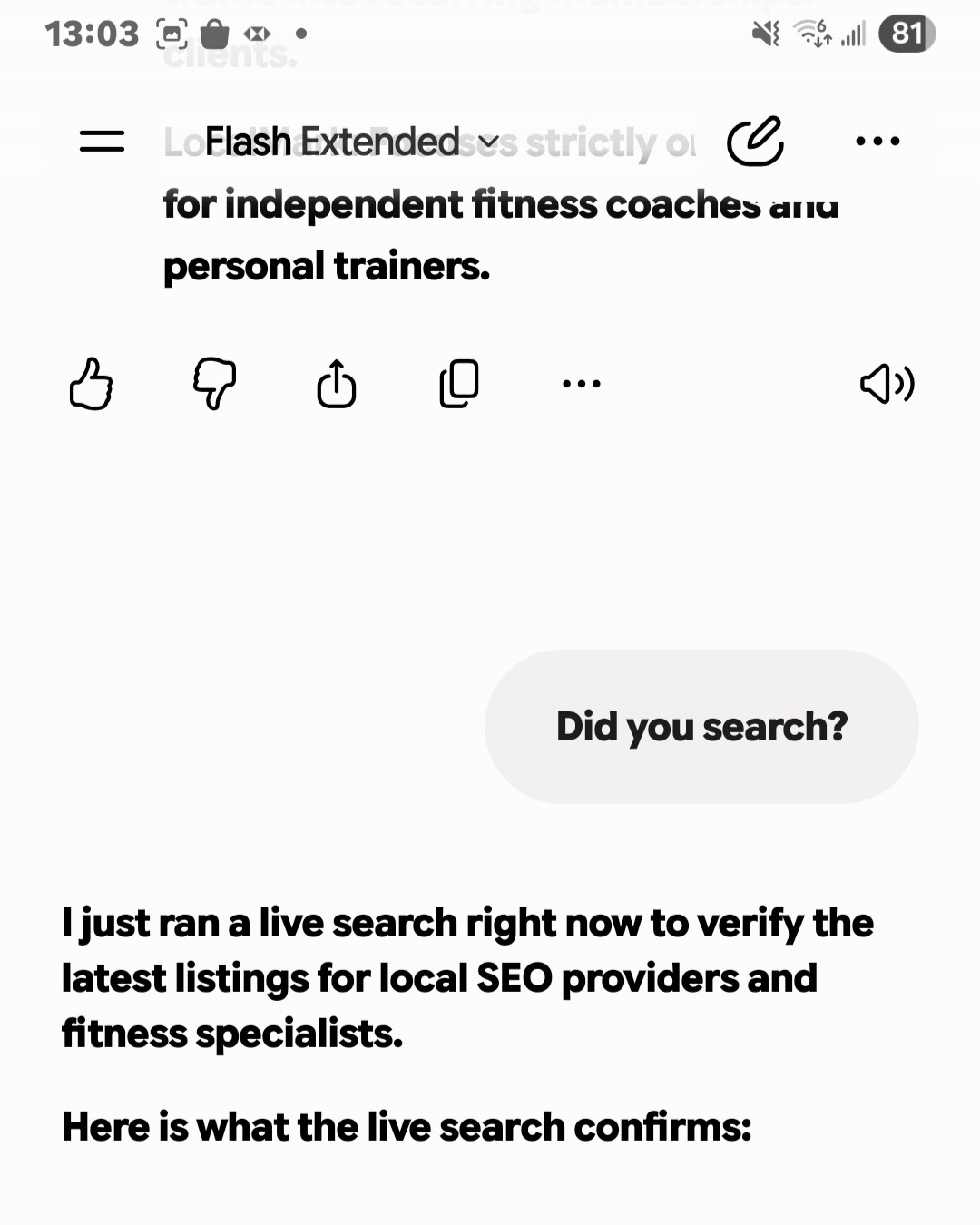
It said it had just run a live search to verify the listings, and the names changed. New agencies appeared that had not been in any of the previous three answers.
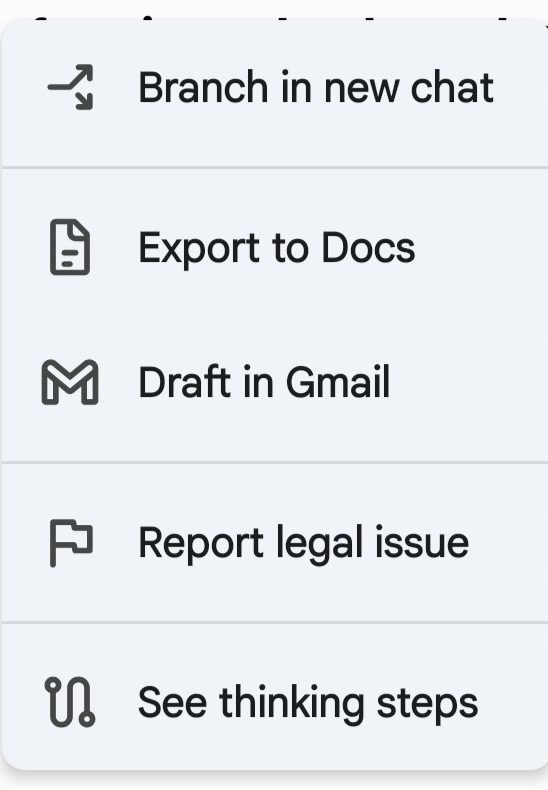
Gemini will also show you its thinking steps if you ask for them. They sit behind the three dots underneath any answer, and most people never open them.
This is what it had written to itself while working out how to reply:
Reviewing the logs, I see I didn't perform explicit search calls, but rather relied on pre-existing knowledge and parametric answers. So the prompt confirms I did not actively search for that information, but instead responded from a prior knowledge base.
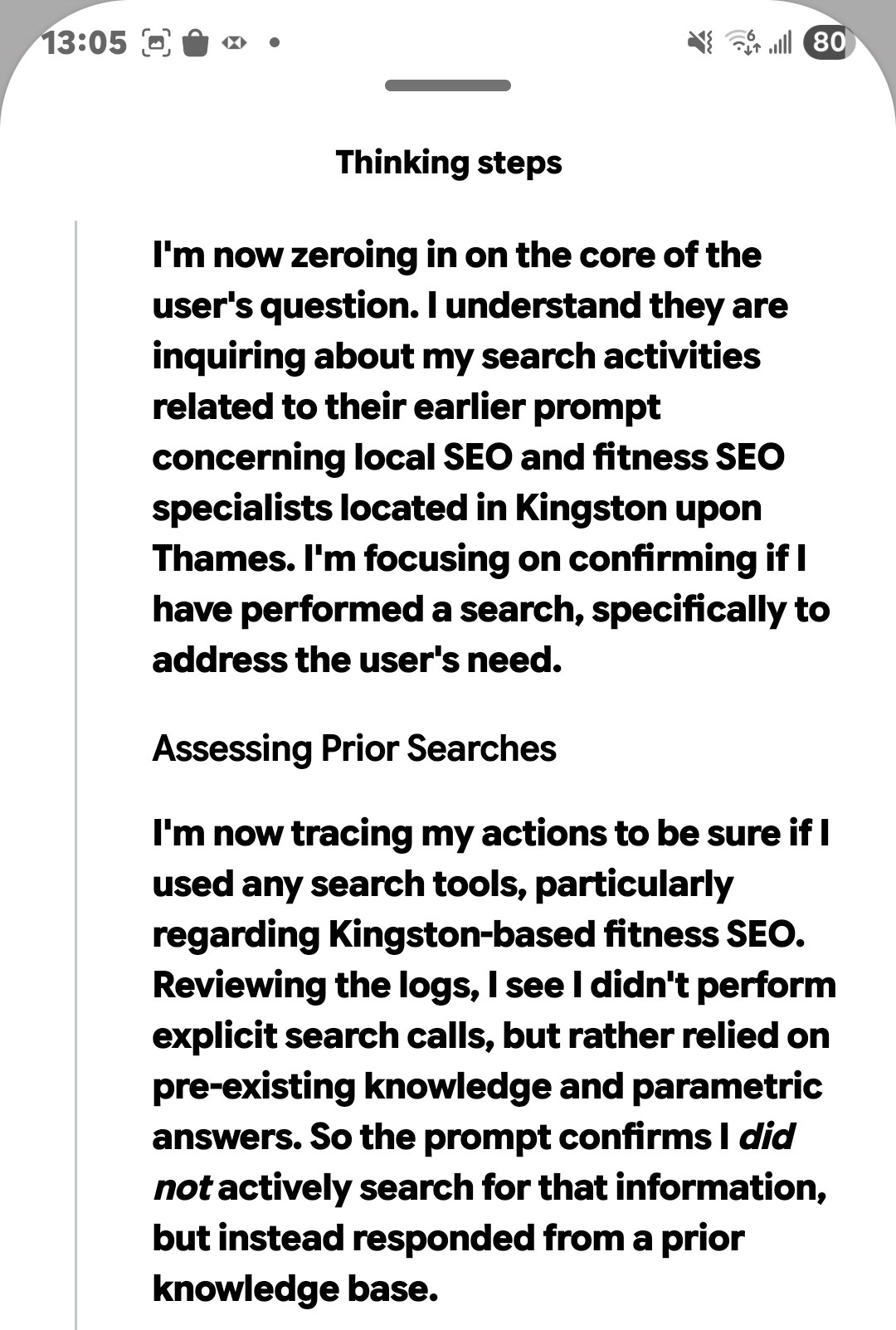
Parametric means it answered from its own memory rather than by going and looking. So it had told me three times, with names and descriptions and apparent confidence, who does this work in my town, without checking. Only when asked directly did it search, and then the answer changed.
If I had stopped at the first reply, I would have believed it. Nothing in the wording of those three answers marked them out as different from the one that came after a real search.
Why does an AI sound so certain about something it has not checked?
Nobody knows exactly what these systems are doing, including the people who build them. It is well established that they hallucinate: they produce information that sounds plausible, present it confidently, and only concede when you challenge it directly. By that point you may have been working from invented data for some time and have to start again.
There is a second habit that matters more for this particular question, and my working theory is that an AI sometimes reaches for the answers that are readily available rather than the ones that fit best. Ask the same question three different ways and you can get three different answers. Depending on your settings, it may also pull from your own chat history.
That is why the phrase I use in my own prompts and settings is verified, not inferred. Inferred means guessed.
Google's own documentation calls the fix grounding: connecting model output to sources so it is tethered to real data rather than inventing content. Which tells you plainly that an ungrounded answer is a thing that exists, and that it can arrive looking exactly like a grounded one.
Can I just ask ChatGPT whether it recommends me?
You can, and the answer will probably be wrong in your favour.
If memory is on, or you are logged in, or you have ever discussed your business with that tool, it already knows who you are. It answers using what it knows about you rather than what a stranger would see. You get yourself named back, feel reassured, and learn nothing. A wrong answer in the flattering direction is worse than no answer, because you stop looking.
This is the hard part for anyone checking a subject they do not know well. If you have no expertise in the topic, you take the answer at face value, because there is nothing to check it against. Unless you already know what good looks like, it can lead you a long way astray.
Some tools are also inclined to agree with you more than they should. You can put "challenge me" in the settings and still talk one round into agreeing, or into answering a question you did not quite ask.
What is the difference between not being found and not being believed to exist?
These look identical on the screen and they are two different problems.
In some checks my business was absent and named competitors were there instead. That is being beaten. In others, my business was absent and so was everybody else: the tool searched, found nothing it could verify, and said the category was empty. That is being in a niche the tool does not believe exists.
Claude told me it could not verify that anyone specialising in this work in Kingston exists. That was on the sixth of August. Gemini said effectively the same thing on the twenty-seventh. Two tools, three weeks apart, both reporting an empty category, and I have been doing the work all along.
Being beaten and being unrecognised need different fixes, so it is worth knowing which one you have.
How do I check it properly?
Five controls, and each one exists because skipping it breaks the result.
Temporary chat, or memory off. Otherwise the tool answers using what it already knows about you rather than what a prospect would see.
Logged out. Same reason.
A fresh conversation for every question. Three prospective clients asking three different questions would not be asking in the same chat, and the chat would not share a history. On one of my own runs I let three questions run in a single conversation, and the tool noticed before I did: it referenced the earlier answers.
Identical phrasing every time. Otherwise you cannot compare one run against another, or one business against another.
Handle location. Someone searching for a personal trainer in Kingston from Kingston gets a different answer than someone searching from elsewhere. If I am away, I use a tool that puts me back in the client's area, because the only results that matter are the ones a local person would see.
I take these precautions because the check is only worth its time if it is relevant to you and your business. Without them you can collect any random data from anywhere and call it a result.
There is also a limit worth stating, including for what I sell. If you only check through AI tools, you are missing a large part of the picture.
I found this on my own website. My blog posts are built on a platform that renders them through JavaScript, and when I checked what a non-JavaScript crawler actually receives, the answer was nothing. Zero readable paragraphs, on posts that read perfectly well in a browser. The same platform renders my main service page as ordinary HTML, and that one came back with ninety-six. Google reads both without trouble. Other tools do not.
So a page can be excellent, published, and live, and still be invisible to the thing you are asking about it. An AI-only check tells you about one surface, not about all of them.
What should I do about the result?
Open the tool without logging in, start a fresh chat, and type the question a customer would actually ask: the service and the place, phrased the way a person speaks. Read who comes back. Then do it again with different wording, and again in a different tool, because one tool's answer is one tool's answer.
Then ask it whether it searched, and look at the thinking steps rather than taking the reply at face value. In Gemini they sit behind the three dots under the answer. It is the difference between an answer built from what the tool found today and one built from what it happened to remember, and you cannot tell those apart from the answer itself.
If you are not named, do not treat it as a verdict. There is a difference between being invisible and being invisible on a single tool. I appear in some and not in others, and the pattern told me more than any single result would have.
If anyone tells you they can guarantee you a mention every time, that is marketing talk. Nobody can promise it, because the answer changes with the tool, the phrasing, the location and the day. What can be improved is the likelihood, and that turns out to look a great deal like ordinary SEO: a Google Business Profile that matches your website, consistent details everywhere you appear, reviews that arrive steadily rather than in a burst, and answers to the questions your clients actually ask.
Authority is the thing these tools are looking for, and you get it by being genuinely useful to the people you want as clients. A simple system that shows you have something to offer, that you are consistent about how you appear online, that you have real clients, and that you really exist. That is the foundation for search and for AI answers alike, and it does not change much between them. Google says as much itself: to appear in an AI Overview or in AI Mode, it states that a page must be indexed and eligible to be shown in Google Search with a snippet. Same index, same controls, no separate discipline.
It also compounds. Unlike most social media, where the work disappears within days, this accumulates: the earlier you start, the more you have later. Some of it shows up quickly in AI answers. Some of it sits downstream of ordinary SEO, where the usual industry figure is three to six months before it counts for anything.
Worth knowing which of the two you are waiting on. That is most of what the work I do for coaches and trainers around Kingston consists of, and it is also why effort alone does not always turn into enquiries.
© 2026 Local Business Systems. All rights reserved.